
Why project management matters at all
In many companies, projects start very simply. Someone has an idea. A customer sends a request. An internal topic finally needs to be implemented. At the beginning, everything is still manageable.
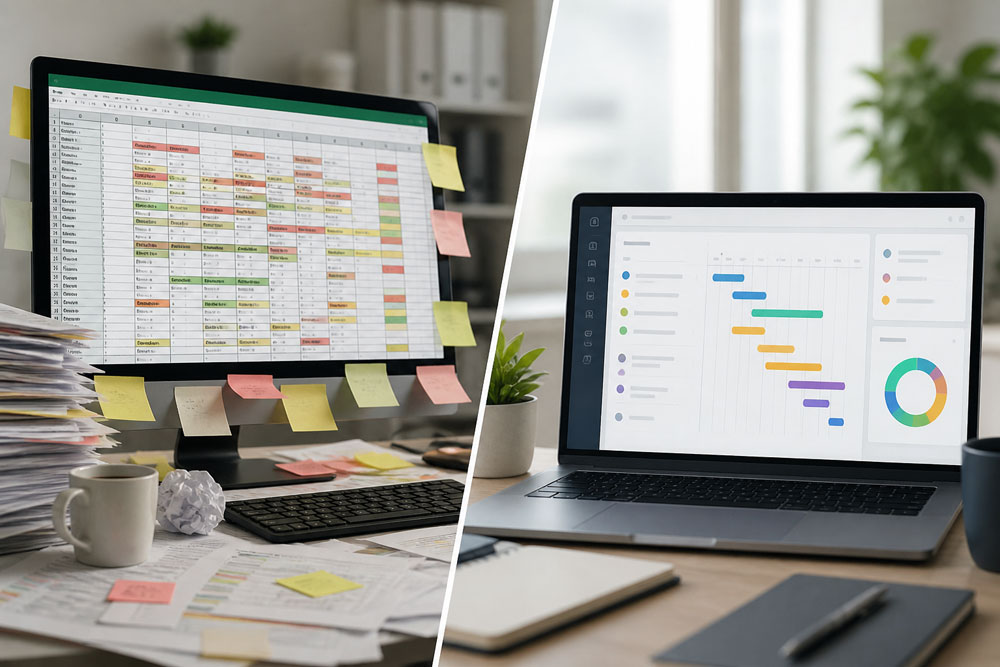
Then the first tasks are added. One person writes an email. Another makes a note. Someone mentions three more open points in a meeting. After a few days, part of it is in someone’s head, part of it is in the inbox and part of it is somewhere in a spreadsheet.
This is exactly where project management begins.
Not as a big rulebook. Not as a complicated method. But as help, so everyone involved knows what it is about, what needs to be done and who is working on which topic right now.
What project management means for SMEs
For SMEs, project management means one thing above all: bringing order into daily work.
A project can be many things. A new website. The introduction of a new tool. An internal improvement. A customer request with several steps. An event. A product launch. Or simply an initiative that includes more than one task.
As soon as several tasks, people or deadlines come together, it is worth looking at the whole thing as a project.
The goal is not to plan everything perfectly. The goal is to forget less, react faster and work more clearly together.
The most important parts of a project
A project does not need a complicated structure. To get started, a few simple questions are usually enough:
What exactly is it about?
A project needs a clear goal. It does not have to be perfectly worded, but it should be understandable. Everyone should have roughly the same picture in mind.
Example: We want to revise our website.
That is better than: We should do something about the website sometime.
Which tasks belong to it?
A project consists of tasks. These tasks make visible what really needs to be done.
For a website, these could be tasks such as check texts, collect images, test contact form or approve content.
The more specifically a task is described, the easier it is to complete.
Who takes care of it?
Many tasks remain unfinished because it is not clear who is responsible. Simple project management ensures that every important task has a responsible person.
That does not mean this person has to do everything alone. But they keep the ball rolling.
What is the next step?
Especially in small teams, a big schedule is not always necessary. Often it is enough to be clear about what should happen next.
This keeps a project moving without making it feel heavy.
Why many tools feel too big in everyday work
Many project management tools are powerful. You can build dependencies, create diagrams, manage budgets, define roles and generate reports.
That sounds impressive. But in the everyday work of small teams, it often leads to a different question:
Do we really have to fill all of this in?
When a tool creates more effort than clarity, people quickly avoid it. Then tasks end up back in emails, chats or personal notes.
Good project management for SMEs should therefore be simple enough so it is actually used.
Better a clear task list that is maintained than a huge system that nobody opens.
Project management is not bureaucracy
A common mistake is to confuse project management with bureaucracy.
Good project management is actually the opposite. It should make work easier. It should prevent things from having to be explained three times. It should help people make decisions faster and spend less time searching.
When someone asks about the status of a project, the answer should not have to be pieced together from ten chat messages, three emails and an outdated spreadsheet.
A simple project overview saves time. And it takes pressure off the team, because less needs to be kept in someone’s head.
Typical problems without clear project management
Without a clear project structure, the same problems often appear:
- Tasks are forgotten.
- Responsibilities are unclear.
- Deadlines are noticed too late.
- Information is stored in different places.
- Meetings keep circling around the same questions.
- Individual people become bottlenecks because only they know what is currently happening.
All of this does not happen because teams are badly organized. It happens because work quickly becomes scattered in everyday life. That is exactly why there needs to be one place where projects and tasks come together visibly.
What simple project management can look like in everyday work
A good start is a simple overview for each project.
It shows what the goal of the project is, which tasks are open, who is responsible and what has already been completed.
At the beginning, more is often not needed.
What matters is that the overview remains easy to understand. Nobody should need training first just to see what needs to be done.
A simple system answers these questions at a glance:
- What is currently running
- What is open
- Who is responsible
- What has been completed
- Where things are still stuck
If these questions can be answered quickly, a lot has already been gained.
The role of tasks in project management
Tasks are the part of a project that really leads to action.
A project like Create new website is still quite large. The task Check homepage text, on the other hand, is concrete. You know what needs to be done. You can assign it to someone. You can complete it.
That is why it is helpful to break projects down into smaller tasks.
Not too small, otherwise it becomes tedious. But not too large either, otherwise nobody knows where to start.
A good task is understandable, doable and has a clear next step.
Project management for small teams
Small teams often do not need heavy processes. They need clarity.
- Who does what?
- What is urgent?
- What has been decided?
- What is still waiting?
This clarity is especially important when people take on several roles. In SMEs, someone may be responsible for customers, administration, technology and internal projects at the same time. It helps enormously when tasks are not floating around loosely in everyday work.
Simple project management creates a shared view of the work. Not to exercise control, but to make collaboration easier.
Why less is often better
Many teams start motivated with new tools and enter a lot at the beginning. After a short time, it becomes too much. Too many fields. Too many views. Too many rules.
Then what almost always happens, happens: The system is no longer maintained.
For SMEs, a lean approach is often better.
One project. One clear task list. One understandable status. One simple overview.
That is completely enough for many initiatives.
More structure can always be added later. But getting started should remain easy.
Project management does not mean rolling out software
Many small teams shy away from the term because they picture something that first costs weeks: choose a tool, buy licences, train everyone, hand out access, assign permissions.
With five people that effort is out of all proportion to the benefit. And that is exactly why it ends up being sticky notes, chat messages and a spreadsheet nobody maintains.
Project management does not start with a rollout. It starts with a single project that is visible.
The pragmatic way is to start small and not force anyone to register first. A kanban board can be created and shared by link – whoever looks at it sees immediately what is being worked on.
Where Projoodle comes into the picture
Projoodle is interesting exactly because of this idea: project work should become easier, not harder.
Instead of first building a complex system, it is about quickly getting from an idea to a usable structure. Projects and tasks should become visible without small teams getting lost in features.
It becomes especially interesting when AI helps turn a rough idea into first tasks. Because often the actual problem is not the tool, but the start.
- What belongs to this project
- Which tasks should we not forget
- How could the whole thing be divided sensibly
When these first steps become easier, the chance increases that projects really get moving.
A simple example from everyday work
Let us imagine that a small company wants to present a new service on the website.
Without project management, it might look like this:
Someone writes an email to the team. One person collects notes. Another looks for images. It is discussed in the next meeting. After that, it is unclear who finalizes the text. Two weeks later, someone asks about the status.
With simple project management, it looks different:
- The project is called "Present new service on website".
- It includes tasks such as collect content, write text draft, select images, create page, check page and approve publication.
Every task has a responsible person. Everyone sees what is open. Progress is visible.
The project has not become more complicated because of this. It has become clearer.
Conclusion
Project management for SMEs does not have to be big, dry or complicated. It is not about knowing as many methods as possible. It is about making work more visible.
Good project management helps teams keep an overview, distribute tasks sensibly and move projects forward step by step.
The best way to start is simple: a clear goal, concrete tasks, visible responsibilities and an overview that is actually used.
When project management is understood like this, it is not extra effort. It becomes support in everyday work.
And that is exactly where it belongs.
Related: project management · Capturing recurring routines in a team