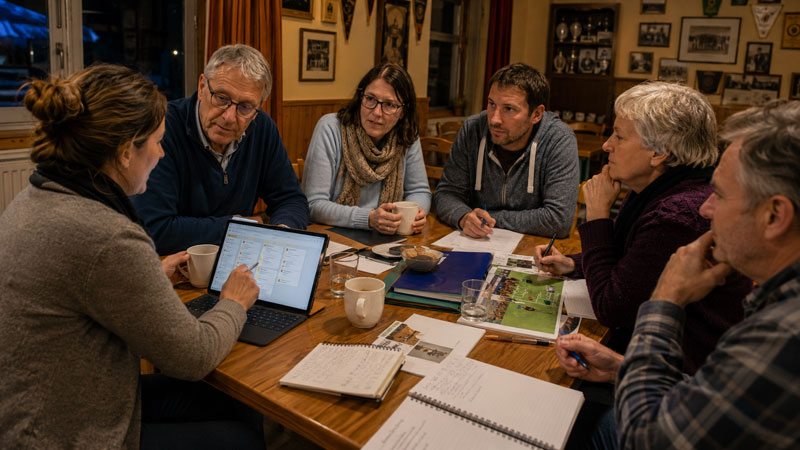

The people at the edges
A website project rarely involves only the agency. There is the client who has to approve the wireframes. The person in marketing who supplies the texts. The IT contact who provides an access. The photographer who delivers images once and is never heard from again.
None of them work in your project tool. And none of them will start doing so for a single task.
Why the client does not sign up
From the agency's side it looks like a small ask: create an account, confirm the email, done. From the client's side it looks different.
They need a password they will forget. They need to remember which of the four agencies they work with uses which tool. In larger companies they may need IT to approve a new service first, and that can take weeks.
The effort is not large in absolute terms. It is large compared to the task, which is often a single yes.
What happens instead
The task moves back into email. Someone exports a list, attaches it, and writes "see attached". The client replies to the email instead of the task. Two days later a second version follows, and now there are two attachments and nobody is sure which one is current.
The work does not disappear, it just becomes invisible to the tool. And that is worse than not using a tool at all, because now the team believes the status is in the system.
What an approval actually needs
Strip it down and a client approval needs surprisingly little:
- The item that is being approved
- A place to say yes, no, or "with this change"
- Somewhere to put a file, if one is involved
- A record of what was decided, for later
What it does not need is a user account, a role concept or a permission matrix.
Sharing without an account
This is what Projoodle is built around. A to-do list or a checklist can be shared with a link. Whoever has the link sees the tasks, ticks items off and adds comments. Files belonging to a task can be attached directly to it.
No registration, on either side. The client opens the link and is in.
Once several deliverables run in parallel, a kanban board shows the whole project at a glance, and that link can be shared just as easily.
What changes for the agency
The obvious gain is that feedback lands where the work is instead of in a mailbox. The less obvious one matters more: the project status stops being something you produce and becomes something that is simply true.
Nobody assembles a status report before the weekly call. The client looks at the same board the team looks at.
The same holds for the call itself. Three slots proposed by email come back as three answers in three places, and somebody adds them up by hand. A date poll without an account asks no more of the client than the approval does: open the link, answer, done.
When an account still makes sense
For your own team it does. People who work in projects every day want their own overview, their assignments and their history. That is exactly what an account is for.
The point is not that accounts are bad. The point is that requiring one from everybody is what breaks the process, because the people at the edges are the ones who decide whether a project moves.
The same holds for a personal task app. For your own list it is the right tool; it only gets awkward where other people show up on it, and the account is what they trip over. That is the subject of a Todoist alternative for projects with changing participants.
In short
An agency project has an inside and an edge. The inside is well served by most tools. The edge is where things get lost, and it is where the difference between "one click" and "please create an account" decides whether the feedback arrives at all.
More on working with external people is in Managing tasks in a team, including external people. And if your current tool feels heavier than the work itself, Project tools are often too complicated covers that. The same argument on a building site, where nobody installs anything either, is in Logging defects on site without an app.