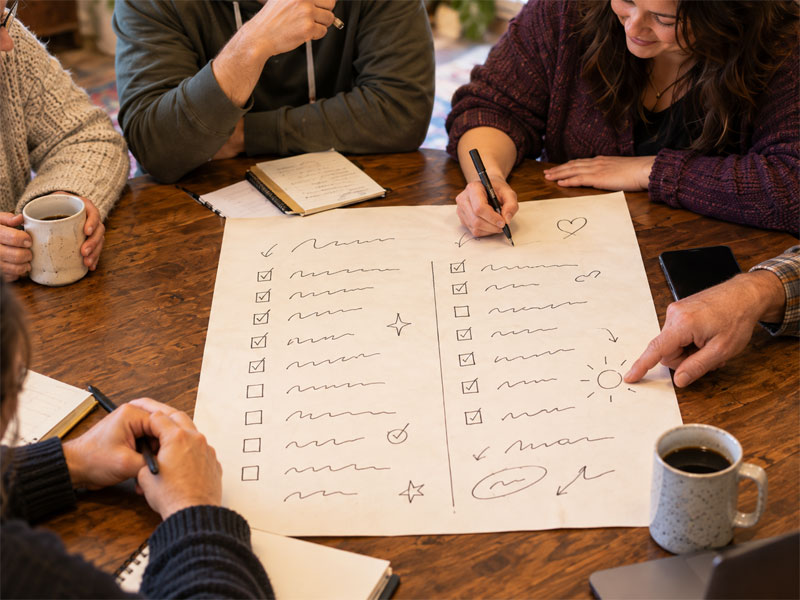

The first item is always the same
Committee meeting, eight in the evening. Item one: matters arising from the last meeting. Somebody opens the minutes on their phone and reads them out. At each entry the room looks around.
The licence – did anyone apply for it? One of them thinks so but is not sure. The request to the band went out, but whether an answer came back is known only to somebody who is not here tonight.
Twenty minutes for the first item. And there are eight more.
The minutes are an archive, not a place to work
They get written, circulated and filed. With that they have done their job – formally, legally, for the AGM.
What they are not is the place where the work happens between two meetings. Nobody opens a PDF from 14 May to check what they promised. Six weeks later nobody knows where things stand, and the next meeting starts by reconstructing it.
A club writes down more than most companies. It just files it where nobody works.
What a meeting actually produces
Stripped down, a committee meeting does not produce a document. It produces a handful of open items:
- what needs doing
- who is doing it
- by when
- whether it is done
The minutes are the packaging around those four things. You can keep packaging. You cannot work with it.
The list that carries on between meetings
For that, a to-do list everyone on the committee can see is enough. It is shared with a link: whoever has it is in. No account, no password, no invitation for anyone to confirm.
On a club committee that is not convenience, it is the condition. Every committee has somebody on it who will not set up another login. If the tool asks people to register, six of the eight use it – and then it is worthless, because the picture is only accurate when everyone is looking at the same one.
Whoever has finished something ticks it off instead of writing an email. Whoever has a question puts it as a comment on the task rather than into a thread that two people were left off.
An events committee is the same, only tighter
An organising committee meets five times and then has a summer fair to put on. Several things run at once: the licence, the bar, the music, the volunteer rota, setting up and clearing away.
As soon as there is more than one strand, a kanban board shows the state of things at a glance – what is open, what is moving, what is done. And, more important in a club than anywhere else: what is sitting there with no name on it.
Because in a club nobody can allocate work. The committee carries the responsibility but cannot instruct anyone. A task with no name against it does not get done because it appears in the minutes. It gets done because somebody notices it.
Those five meetings have to be arranged first, and with eight people that is a week of email every time. A date poll that stays in the project saves more than the searching: the evening everyone settles on lands in the same calendar as the open items.
A club year is several undertakings
The AGM, the summer fair, the anniversary, the club outing – each one its own project, with its own list and its own board. That way the committee keeps an overview without everything landing in a single list.
And this is where it pays off
A club loses part of its memory every year. The person who ran the bar for twelve years steps down. The committee is restaffed. What their predecessors knew – when the licence has to be in, how many trestle tables it takes, which band says yes and which does not – is written down nowhere findable.
In theory it is in the minutes. In practice nobody reads eleven PDFs to work out how the fair was run last year.
Last year's project does exactly what the minutes archive promises and never delivers. Whoever joins the committee opens last year's list and sees the order, the deadlines and what went wrong. They do not have to ring somebody who left the club two years ago.
For events that run the same way every year, a checklist that stays put is worth having on top. More on that in Capturing recurring routines in a team.
Where it stops
So it is clear what this is not:
- No membership administration, no subscriptions, no bookkeeping, no fundraising. Anyone who needs that needs club software. Projoodle sits beside it, not above it.
- No membership data in a shared list. Addresses, dates of birth and payment records do not belong in something reachable by a link. That is not a gap, it is the right separation.
- No volunteer rota with shifts and automatic reminders. Email reminders come with the PRO version only.
What you get instead: nothing to install, no licence per person, no registration. Not even for the committee member who will not be there next year.
In short
A club does not have a documentation problem. It documents impeccably. Its problem is that what it documents sits in a place nobody passes between two meetings.
A list everyone can see and nobody has to unlock turns the minutes into what they should be: a description of what is already running.
How small teams get started without a rollout is in Project management for small teams without a rollout. And if you are wondering what you actually need: Which project tool fits a small team?